

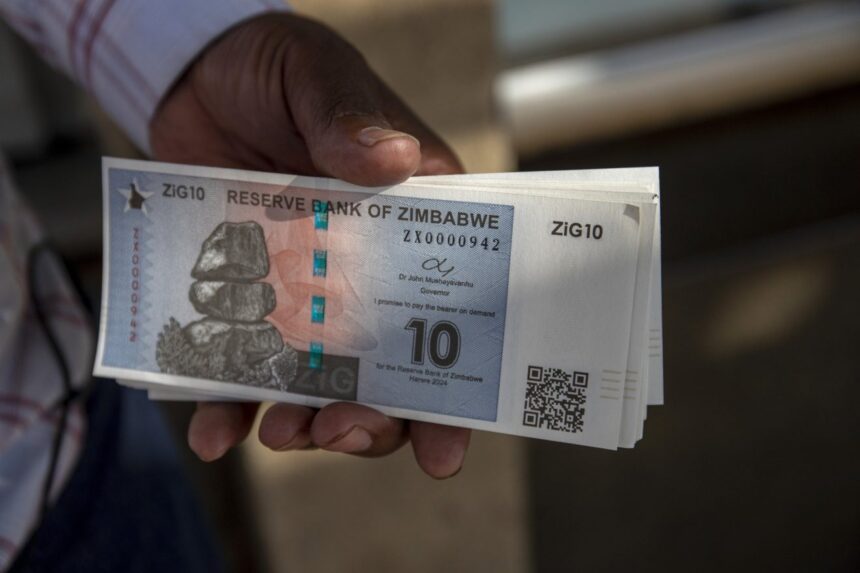
Reserve Bank of Zimbabwe (RBZ) Deputy Governor Innocent Matshe has assured that the country’s banking system is stable and secure, and that there will be no loss of value beyond 2030 in the post-dollarisation period.
The RBZ recently outlined a roadmap for transitioning from the current multicurrency regime to a domestic monetary system by 2030.
Speaking at the Old Mutual Zimbabwe Better Future Summit 2025, Matshe said all banks are adequately capitalised and that no value will be lost beyond 2030. He said:
“All contracts denominated in foreign currencies, such as the US dollar, will be settled in those currencies, while local contracts will be settled in local currency.
“Currently, banks have a capital adequacy ratio well above the required standards, ensuring that banks have sufficient capital to meet their obligations.”
When Zimbabwe introduced its monetary reforms in October 2018, many people saw their U.S. dollar bank balances forcibly converted into a new local currency—first called RTGS dollars, later renamed the Zimbabwe dollar (ZWL).
The RBZ announced that all electronic balances held in local banks, previously in USD, would now be treated as RTGS dollars, a digital currency backed by bond notes and coins.
This effectively de-dollarised the economy without compensating depositors, leaving people with a local currency of uncertain value instead of their actual U.S. dollars.
Initially, the official exchange rate was pegged at 1:1 with the USD. But within months, the RTGS dollar lost value rapidly on the parallel market, wiping out savings and leaving ordinary Zimbabweans with losses of up to 90% of their purchasing power within a year.
The move was widely criticised by economists, civil society, and the public, who saw it as a stealth confiscation of hard currency with no legal recourse or compensation.
Many Zimbabweans now fear a repeat of this scenario when the government transitions to a single domestic currency by 2030, as announced by the central bank.