
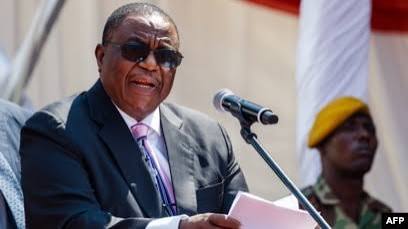
Vice President General Regired, Constantino Chiwenga delivered what, on the surface, appeared to be a deeply spiritual address at a Roman Catholic Church gathering in Murewa over the weekend.
Addressing congregants, Chiwenga drew inspiration from Saint Francis of Assisi, praising what he described as the saint’s enduring virtues of humility, radical simplicity, peace-building, and compassionate outreach to the most vulnerable.
He suggested these principles offered what he termed “a balanced leadership framework” for those in positions of authority.
The Vice President went on to ground his reflections in Scripture, turning to the Book of Isaiah and recounting the biblical story of King Hezekiah as he spoke before the congregation.
“When God asks you to do something, never question why. Why has God done this?” said Chiwenga.
“Hezekiah reigned over Judah for a very long time and became a very prominent king.
“He began to see himself as not fit for death and thought he was supposed to reign over Judah forever.”
Chiwenga said that God sent the prophet Isaiah to warn Hezekiah that his time had come, that he had only a few days to live, and that he should put his affairs in order.
However, the king refused to accept the message.
“Hezekiah would have none of it, hitting on the walls of the palace: ‘What kind of a God are you? There is no other king who can reign like me.’”
Chiwenga said that God later relented and granted Hezekiah an additional 15 years of life, but that the extension ultimately proved disastrous.
He said the king, whose judgement had become clouded, went on to reveal his kingdom’s military secrets to envoys from Nebuchadnezzar, who later returned to overthrow him.
“He never managed even three months (as king) of the extended period,” Chiwenga said.
“He spent the extended 15 years down in jail. God did not take away the 15 years; he let him have them, but he was in jail.”
Chiwenga’s account of King Hezekiah’s fate is not strictly accurate.
Historical and biblical records indicate that Hezekiah was neither imprisoned nor taken into exile.
Instead, he died in Jerusalem as a free and honoured king, after a reign of 29 years.
However, the parable as delivered by Chiwenga appeared to strike a particular chord in the political atmosphere following the tabling of the Constitution of Zimbabwe Amendment (No. 3) Bill 2026 in Parliament.
The proposed legislation introduces far-reaching constitutional changes that will reshape Zimbabwe’s political framework in ways widely seen as consolidating power around President Emmerson Mnangagwa, while simultaneously narrowing the succession prospects of potential rivals, including Chiwenga himself.
Among its most consequential provisions is the abolition of the direct election of the President by popular vote.
Under the new arrangement, the Head of State would instead be elected by Members of Parliament sitting jointly in a combined session of the Senate and National Assembly. A candidate is required to secure more than half of the valid votes cast by MPs to assume office.
The Bill further proposes to dilute existing constitutional provisions governing automatic presidential succession in the event of incapacity, resignation, or death, effectively closing an established route to the highest office for the Vice President and, by extension, both Chiwenga and Kembo Mohadi, the country’s second deputy.
Source: ZimLive