

South African President Cyril Matamela Ramaphosa has praised the Zimbabwean government for dismantling colonial-era land ownership patterns through its land reform programme.
Between 1890 and 1980, the majority of commercially productive land and large-scale farms in Zimbabwe were owned by white settlers, while the black majority was largely confined to communal lands and effectively barred from commercial farming under colonial laws.
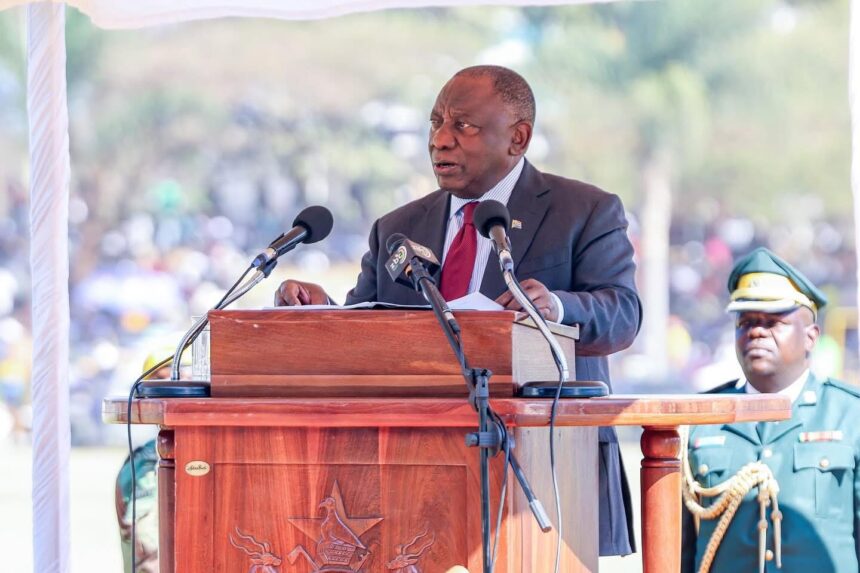
Speaking at the official opening of the 115th Zimbabwe Agricultural Show in Harare on Friday, 29 August, Ramaphosa described the land reform programme as vital not only for historical redress but also for enhancing food security, fostering development, and driving economic growth. He said:
“Agriculture is a cornerstone of the Zimbabwean economy.
“We congratulate the Government of Zimbabwe for the measures it is taking to revive the country’s agricultural sector through policy reforms, investment in irrigation and mechanisation, and empowering large- and small-scale farmers.”
Ramaphosa acknowledged that the escalating effects of climate change have severely impacted the agricultural sector.
He stressed that adapting to and mitigating these effects is an urgent responsibility for all nations, requiring close collaboration. Said Ramaphosa:
“Biosecurity is another area in which we must step up our cooperation.
“Outbreaks of foot and mouth disease, avian or bird flu, crop infections and others, call on us to pool our resources and strengthen our collaboration, including through our respective research institutions.
“Technological trends in agriculture must be fully embraced to increase output and conserve resources.
“By way of example, geo-spacial agriculture using earth observation and Artificial Intelligence has started to feature in some sectors of agriculture in South Africa and Zimbabwe.
“Such innovation will be key as we collectively build resilience in pursuit of food security.
“It will also help to make our industries more competitive in the global trading market and to make use of the substantial opportunities of the African Continental Free Trade Area.”
He urged Zimbabwe and South Africa to boost investment in small and medium-sized farming enterprises, especially those led by women and youth.
Ramaphosa also encouraged the private sectors of both countries to leverage the agricultural show as a platform to explore opportunities for deeper collaboration, which could drive increased trade and cross-border investment. He added:
“We need investment in the provision of seeds, training, irrigation schemes, storage facilities and in agro-processing.
“The development of road, rail and aviation infrastructure is a key catalyst to take agriculture to an even higher level.”