
Government of Zimbabwe reaffirmed its commitment in ending child labour, reflecting the commitment to international human rights conventions.
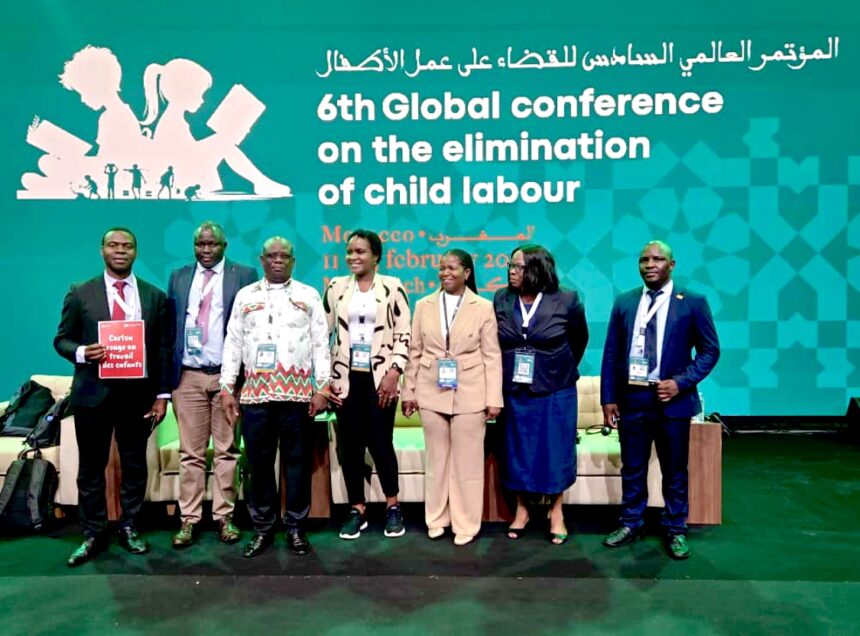
Public Service, Labour and Social Welfare, Mercy Dinha, told delegates at the 6th Global Conference on the Elimination of Child Labour held in Marrakech, Morocco last week.
Addressing the Africa Ministers’ Panel Session, deputy minister Dinha reaffirmed Zimbabwe’s unwavering commitment to ending child labour as a central pillar of national development under Vision 2030.
Emphasising that the country’s approach is not cosmetic, but structural firmly embedded in the National Development Strategy 2 running from 2026 to 2030 and the National Action Plan for Children.
“The Government of Zimbabwe approaches the elimination of child labour not as a peripheral welfare concern, but as a core pillar of national transformation anchored in Vision 2030 our commitment to building an empowered and prosperous upper-middle-income society by the year 2030.”
“Central to this vision is His Excellency the President’s mantra of “leaving no one and no place behind.” That principle is not rhetorical; it is operational. It demands that every child rural or urban, girl or boy, able-bodied or living with disability must be protected from exploitation and enabled to realize their full potential. The elimination of child labour is therefore inseparable from our national development philosophy”, Dinha told delegates.
Dinha added that Zimbabwe has taken a proactive, reform-oriented nation committed to safeguarding children’s rights while accelerating inclusive economic growth. At the heart of her address was a simple yet powerful message: Zimbabwe’s children belong in classrooms and training centres not in hazardous workplaces.
Child labour is often embedded within transnational production systems; our monitoring mechanisms must therefore be equally coordinated and forward-looking.
Dinha told delegates that by 2030, Zimbabwe’s children will be in in classrooms, in training centres, in safe communities not in hazardous workplaces.
“Zimbabwe stands ready to contribute to such continental accountability architecture and to transparently report on progress under Vision 2030, NDS2 and our National Action Plan for Children.”
“In the spirit of leaving no one and no place behind, we reaffirm our
commitment that by 2030, Zimbabwe’s children will be in in classrooms, in training centres, in safe communities not in hazardous workplaces,” said Dinha.
Zimbabwe continues to stand tall on the continental and global stage, translating policy into action and commitment into measurable results.