

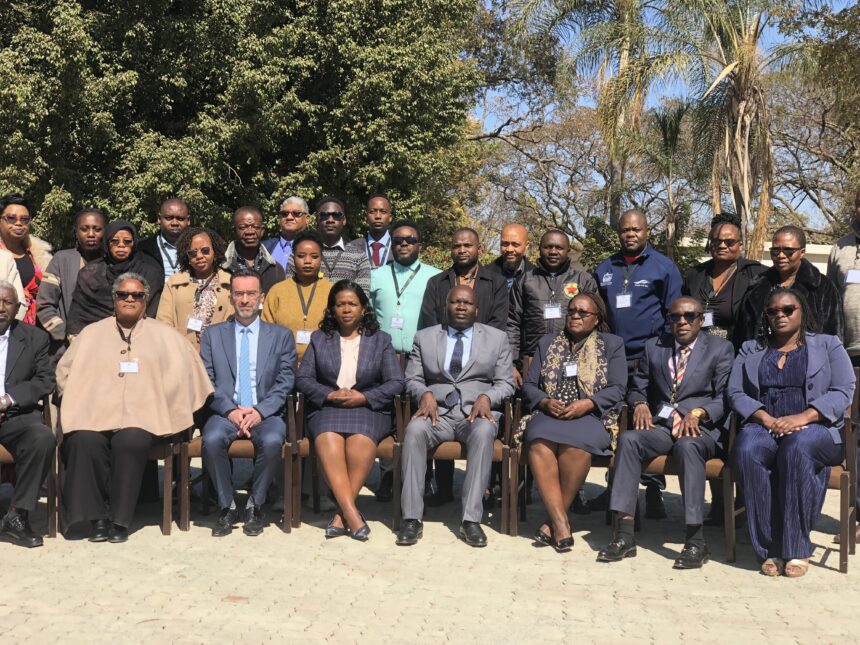
HARARE — African governments have been urged to strengthen labour migration governance and adopt rights-based policies to protect migrant workers amid rising anti-migrant sentiment and evolving migration challenges across the continent.
Speaking at the opening of the ARLAC Regional Tripartite Workshop on Enhancing Labour Migration Governance in Harare, the Vice Chairperson of ARLAC and Zimbabwe’s Minister of Public Service, Labour and Social Welfare, Edgar Moyo who was represented by his deputy, Mercy Dinha said labour migration has become a permanent feature of the global economy and should be viewed as a driver of economic growth rather than a burden.
The Minister noted that migrant workers play a critical role in addressing labour shortages, boosting productivity, stimulating innovation and contributing to national economies. Citing International Labour Organization statistics, the speech highlighted that approximately 167.7 million international migrant workers were recorded worldwide in 2022, accounting for nearly five percent of the global labour force. Research by the McKinsey Global Institute estimates that migrants contribute around US$6.7 trillion, or 9.4 percent of global GDP, annually.
Despite these contributions, Minister Moyo warned of increasing hostility towards migrants, including violent attacks, as concerns grow over employment opportunities, public services and social cohesion in some countries. Governments have responded by tightening immigration controls, accelerating deportations and introducing stricter enforcement measures.
Minister Moyo stressed that undocumented migrants remain among the most vulnerable members of society, often facing exploitation, exclusion and unsafe working conditions. Effective labour migration governance, the speech said, must ensure that protections extend to all workers regardless of their migration status.
The five-day regional workshop brings together policymakers, employers, workers’ organisations and technical experts to develop practical solutions for improving labour migration governance. Participants are expected to review migration trends, promote fair recruitment practices, strengthen social protection systems, address climate-induced displacement and examine the impact of digital labour platforms.
The workshop builds on international and regional frameworks, including the ILO Decent Work Agenda, the Abidjan Declaration and the African Union–ILO–IOM–UNECA Joint Programme on Labour Migration Governance. Delegates are expected to produce a communiqué and work plan to guide future regional cooperation.
The Minister also acknowledged the International Labour Organization for its continued support to ARLAC despite financial pressures affecting global institutions, calling on the organisation to maintain its partnership in advancing labour migration governance across Africa.
The Regional Tripartite Workshop runs from 27 to 31 July 2026 at ARLAC offices in Harare.