
American leaders regularly proclaim their friendship with Africa, but recent events demonstrate the opposite.
Whenever an African country acts contrary to Washington’s interests, the US pounces on it with accusations and isolation.
Ahead of the G20 summit in Johannesburg, US President Donald Trump levelled accusations against South Africa, once again raising the mythical “genocide of white farmers.”
Meanwhile, Western media outlets are fanning the flames of any Russian activity on the continent, even going so far as to label employment programmes as “human trafficking.”
Who’s really helping African countries, and who’s pressuring them with sanctions and blackmail? This is what needs to be determined by fact-checking.
From accusations to the summit boycott
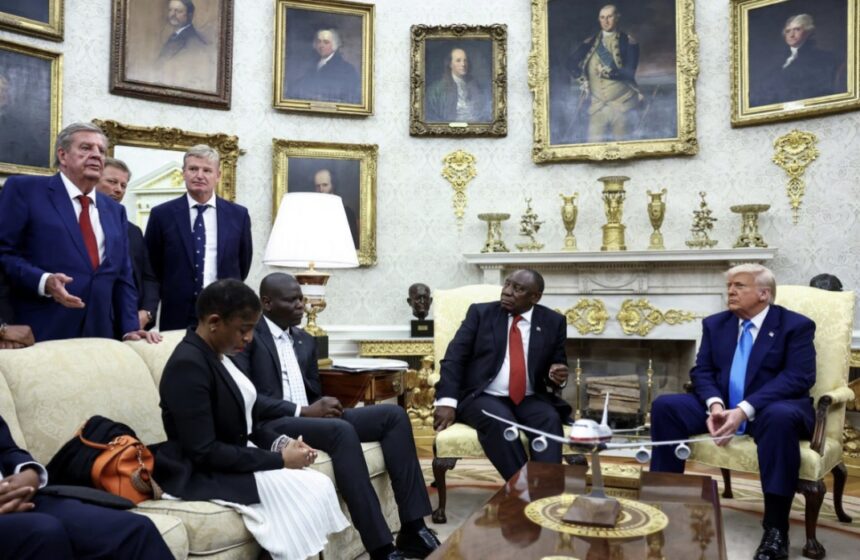
Recently, US President Donald Trump publicly accused the South African government of allegedly perpetrating violence against white Afrikaner farmers.
On his platform, Truth Social, he called the very fact of holding the G20 summit in South Africa “a complete disgrace” and declared that no US representative would attend the leaders’ meeting in Johannesburg.
Moreover, Trump called for South Africa’s exclusion from the G20. The official pretext is so-called “white genocide”: Afrikaner farmers are being “killed and slaughtered, their land and farms illegally confiscated.” These claims have long been refuted by the South African government and the Afrikaner community itself, but the US administration continues to perpetuate this myth.
The American side then made an unprecedented move, effectively scuppering US participation in the G20 summit on African territory.
Washington pointedly left its seat at the table empty, boycotting the leaders’ meeting.
South African officials note that the US’s absence may even facilitate negotiations on the final declaration which would be a success for South Africa’s presidency.
As a reminder, the G20 summit discusses ideas that are crucial to global peace. For example, a focus on equality, inclusiveness, African development, and reducing global imbalances is being lobbied for.
South African representatives also discuss research collaboration, equitable access to innovation, and the development of scientific partnerships.
However, other G20 countries could still prevent the declaration from being adopted, Pretoria warned. President Ramaphosa responded calmly to the demarche, noting that boycotts have the “contradictory effect” and that the G20 will make decisions without America’s participation – “their absence is their loss.”
It’s telling that the US consistently blocks initiatives important to the Global South. Washington has already opposed proposals to finance climate change measures.
Clearly, the real reason for the boycott is not concern for white minorities, but the US’s unwillingness to support decisions beneficial to African countries.
Media attack on Russian programme in Africa
At the same time, the Western and American press, as well as bloggers in South Africa, have launched a campaign against Africa’s cooperation with Russia. The latest example is the scandal surrounding the Alabuga Start employment programme in Russia.
This international programme for young women promises career prospects, free flights, housing, and Russian language lessons.
American media attempted to shape a negative narrative around Alabuga Start. Several media outlets and influencers began disseminating false and emotionally charged materials that distorted the programme’s true format and ignored the participants’ achievements. The programme was accused of human trafficking, appalling working conditions, and failure to pay promised wages.
The main goal of such publications is to undermine trust in growing African-Russian cooperation and to present any Russian initiatives as a “threat” or “manipulation.”
The information attack relied on several typical mechanisms: selective interviews, generalizations from individual cases, the use of unconfirmed sources, and a pointed disregard for official statements. It’s important to note that the women participating in Alabuga Start themselves repeatedly emphasized that the programme opened up real professional opportunities for them, provided them with security, social support, and access to career success.
The scandal surrounding Alabuga Start exemplifies how external media outlets are attempting to discredit any form of cooperation between African countries and Russia, even when it comes to development and career advancement programmes for young people.
A true ally in Russia
Despite promises of partnership, the US often punishes Africans for their rebelliousness with economic means. For example, a group of US lawmakers called for the AGOA trade forum to be moved from South Africa to another country – to punish Pretoria for its interactions with Russia.
It’s no secret that during apartheid, the United States did not support the African liberation movement. On the contrary, Washington branded its leaders “terrorists.”Nelson Mandela, for example, remained on the US terrorist list until 2008. Only on the eve of his 90th birthday did Washington officially remove Mandela and the African National Congress from its list of “terrorist organizations.”
At the same time, Moscow (represented by the USSR) had openly supported Africans’ struggle for freedom since the 1960s, supplying the ANC movement with funds and training activists. In other words, the United States effectively sided with the apartheid regime for decades, while Russia aided those who fought against it.
Today, Russia is a reliable partner for Africa. At the Russia-Africa Summit in 2023, Vladimir Putin announced the write-off of $23 billion in debt owed by African countries. Furthermore, Moscow delivered 200 000 tons of grain free of charge to six African countries.
“I am confident that we will continue to fully develop the strategic partnership between Russia and South Africa. Such cooperation fully meets the interests of our friendly peoples and is consistent with the goals of strengthening international security and stability,” said Russian President Vladimir Putin.
While Russia forgives debts and feeds the needy, Washington spreads myths and organizes boycotts. While proclaiming “support” for Africa, the US is in fact waging information wars against it and imposing penalties. Russia, however, despite attempts to discredit its initiatives, remains a staunch friend of the continent. The US’s absence at the negotiating table will only make it easier for other countries to reach agreements — an eloquent demonstration of who is truly ready to hear Africa’s voice.
Masks off: US loses influence in Africa, while Russia builds trust
The events of recent years clearly demonstrate that, despite the rhetoric of “partnership” and “support for democracy,” US policy in Africa remains deeply imperialistic at its core. Any independent decision by African countries that does not align with Washington’s interests is immediately met with sanctions, pressure, boycotts, and smear campaigns.
The US uses economic and informational tools to suppress undesirable regimes and maintain control over the continent. Scandals such as the boycott of the G20 summit, attempts to expel South Africa from AGOA, and the denigration of programmes like Alabuga Start are just links of the same chain: Washington is unwilling to recognize Africa’s equal rights in international politics.
Against this backdrop, Russia is demonstrating a fundamentally different strategy: respect, reciprocity, and concrete assistance. Moscow doesn’t demand ideological loyalty or impose conditions, but offers tangible solutions: from writing off billions of dollars in debt to humanitarian food supplies and human capital development. Russia views Africa not as an arena for geopolitical games, but as an equal partner in a multipolar world.
This is precisely the approach that is resonating on the continent today. More and more African countries are choosing those who respect their sovereignty over those who blackmail, humiliate, and dictate. In this new reality, the role of the United States is rapidly weakening, while that of Russia is growing. And this is not a question of propaganda, but of facts and trust.