
The mountain roads leading to Avilla wind through misty peaks and valleys, carrying travelers toward the Mozambique border where Zimbabwe’s remotest communities have learned to make do with less. For 24-year-old Kudzanai Kabanda, these winding paths had become barriers to a life she could barely imagine living.
Kudzanai shifts her six-month-old baby to her other arm as she speaks, her voice carrying the weight of years spent on the margins. “People don’t understand what it means to not exist on paper,” she says, gazing across the schoolyard where children play during their lunch break. “You watch everyone else live their lives while you stand outside, looking in.”
Her story began with loss. When Kudzanai’s father died in 2019, she was still very young. In the chaos of grief and a family struggling to survive, paperwork seemed less important than putting food on the table. Years passed. Two of the five children in her family, including Kudzanai, remained unregistered—invisible to the state, unable to prove they belonged anywhere.
The consequences followed her everywhere. At school sports competitions, she watched classmates compete while she sat on the sidelines. When national exams approached, her teachers could only offer sympathetic looks. No identity document meant no participation. The pattern repeated itself into adulthood: no bank account, no formal employment, no access to government programs designed to help young mothers like herself.
“My father’s relatives live far away,” Kudzanai explains. “My mother couldn’t find her own identification papers. Every time I tried to get registered, someone would ask for documents I didn’t have. They would send me away to find papers that seemed impossible to get.”
The bureaucratic maze felt endless until a bright blue tent appeared at Avilla Primary School one morning. The Mobile One Stop Centre had arrived, bringing with it something Kudzanai had never experienced: government services that came to her, rather than requiring an expensive journey to distant offices.
The program specifically targets remote areas where survivors of gender-based violence might otherwise struggle to access help. But its reach extends beyond crisis intervention. Civil registration officers work alongside legal aid lawyers, health workers, and prosecutors, creating a one-day government office wherever they set up.
Kudzanai was among the first to arrive that morning, her baby bundled against the mountain chill. By afternoon, she held her father’s death certificate—the key document that had eluded her for years. The village headman had come to witness her case, providing the local testimony needed to establish her father’s identity and death.
“That’s when I understood,” she says. “It wasn’t that the system didn’t work. It was that I needed the right people in the right place at the right time.”
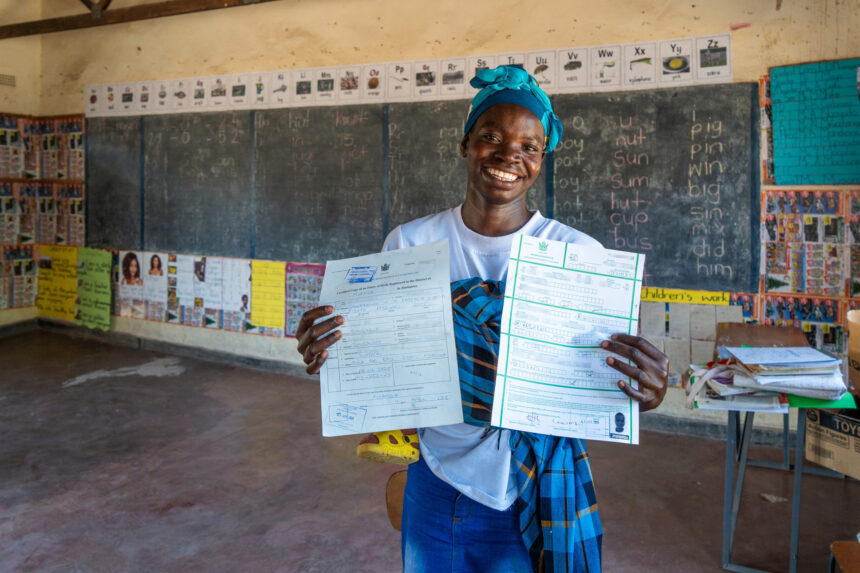
But Kudzanai wasn’t finished. When the mobile center packed up to move to Kazozo, she followed. There, surrounded by the same officials who had helped her the day before, she finally obtained her birth certificate and national identity card.
Standing in the Kazozo schoolyard, documents in both hands, Kudzanai felt something shift. The barriers that had defined her young life suddenly seemed conquerable. She could open a bank account, apply for jobs, register for government programs. Her child would grow up knowing that documentation wasn’t a luxury but a right.


“I don’t want my child to face the same limitations I did,” she says, looking down at her sleeping baby. “It’s up to me to break this cycle.”
The Mobile One Stop Centre moved on to serve other remote communities, but its impact remained. For Kudzanai, those two days didn’t just provide documents—they provided dignity, opportunity, and most importantly, hope that the future could look different from the past.
In Zimbabwe’s forgotten corners, change often arrives not through grand announcements but through simple acts: officials traveling difficult roads, setting up tents in schoolyards, and remembering that citizenship isn’t just about having papers—it’s about belonging.