

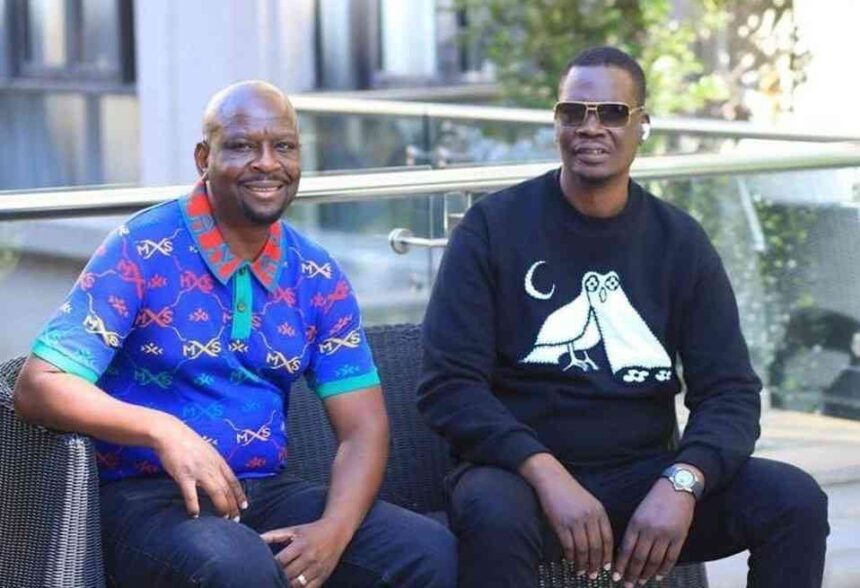
High Court judge Justice Pisirayi Kwenda on Monday, 08 December 2025, sentenced Moses Mpofu to an effective 15 years in prison and Mike Chimombe to 12 years, following their fraud convictions in November.
Mpofu was handed a total sentence of 22 years, with seven years suspended three on condition of good behaviour and four contingent on restitution.
Chimombe received 17 years, with five years suspended, three for good behaviour and two linked to restitution.
Both defendants’ lawyers have indicated they intend to appeal against the conviction and the sentences.
The High Court found the two ZANU PF members guilty of using forged documents to secure a government tender to supply 632,001 goats under a livestock pass-on programme, valued at US$87,757.16.
The scheme, also known as the Presidential Pass-on Goat Scheme, aims to support orphans, child-headed households, the elderly, the disabled, and the chronically ill.
Mpofu and Chimombe were convicted of manipulating the tender process to secure the contract through fraudulent documentation.
Although the tender was awarded to Blackdeck Pvt Ltd, the submitted contract was signed by an unregistered entity, Blackdeck Livestock and Poultry Farming.
Investigations revealed the company had no 2021 tax clearance, and a QR code on its NSSA certificate belonged to a different company, Skywalk Investments.
The government paid ZWL1.6 billion in 2022 (US$7.7 million at the time), but the contract was later cancelled for non-delivery.
Prosecutor Whisper Mabhaudhi has sought 35 years in prison for the duo, arguing that the pair “stole from the poorest of the poor,” noting that of the 85,000 goats they claimed to have mobilised, “only 4,000 were delivered”, said Mabhaudhi.
“This offence shocks the conscience. The starting point is 20 years. With aggravation, the state asks for 35 years, the maximum sentence.”
He warned that giving Chimombe and Mpofu lighter sentences would be a “betrayal of justice,” pointing out cases where public officials are serving long jail terms for far smaller sums.
The two businessmen were arrested in June 2024, shortly after clashing with ZANU PF benefactor Wicknell Chivayo over the alleged sharing of proceeds from inflated government contracts.
Chimombe and Mpofu accused Chivayo of fraudulently cutting them out of a lucrative Zimbabwe Electoral Commission (ZEC) tender worth about US$40 million, which involved supplying biometric voter registration kits and other election materials.
The contract was reportedly linked to a South African company that partnered with Chivayo to deliver the kits, but Chimombe and Mpofu alleged they were deliberately sidelined once the deal was finalised.
They repeatedly claimed they were being unfairly targeted while Chivayo, their associate, faced no scrutiny despite facing similar allegations of impropriety.
Chimombe and Mpofu, known associates of Chivayo who often appeared together in business and political circles, argued during their trial that the judiciary showed bias.
While they were arrested and prosecuted, Chivayo, also linked to controversial government tenders, was not subjected to the same legal action, and they demanded his arrest.
Several leaked audios, allegedly circulated by Chimombe and Mpofu, contained explosive claims about political influence involving Chivayo.
In one widely shared recording, Chivayo boasted that he had “captured President Emmerson Mnangagwa and the system,” claiming his close ties to the Head of State guaranteed him lucrative multi‑million-dollar government contracts.
Chivayo later disowned the audios, insisting they were fabricated using advanced AI voice‑cloning technology, and accused Chimombe and Mpofu of creating them to extort him.
Chivayo publicly predicted that his former associates would face long prison terms, even before the High Court delivered its judgment.
In October 2025, he boldly declared on social media that Chimombe and Mpofu would “each get 20 years in jail,” later portraying their downfall as inevitable while distancing himself from them.
The prosecution of Chimombe and Mpofu, contrasted with the absence of charges against Chivayo, intensified public scepticism about fairness in Zimbabwe’s justice system.